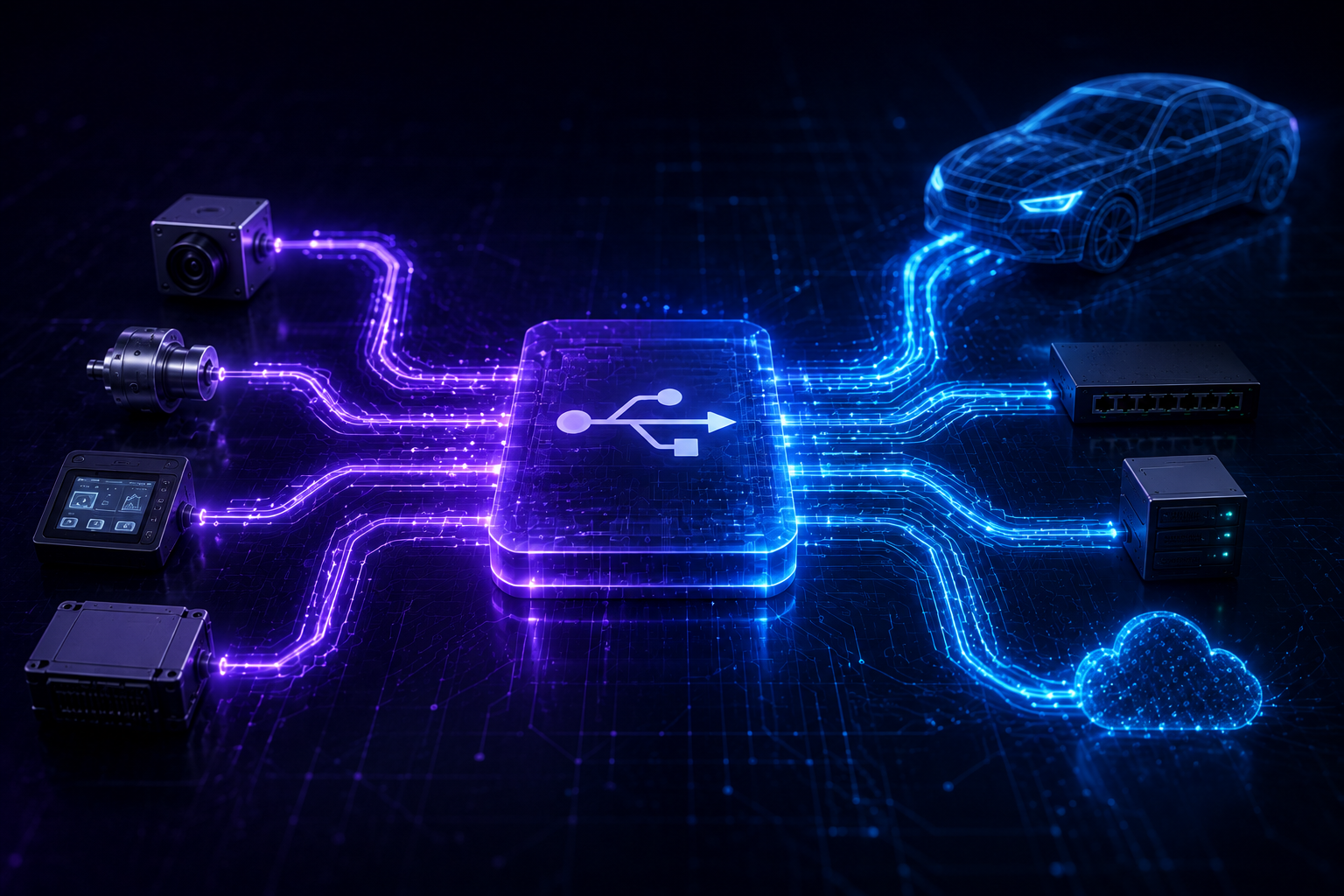
Modern cyber-physical systems rely on both peripheral I/O buses and real-time networks, often requiring separate hardware and software stacks to support each. This research paper explores an alternative architecture that uses USB as a unified fabric for both device I/O and real-time networking.
The authors compare a unified USB architecture with a conventional USB + Time-Sensitive Networking (TSN) approach, evaluating factors including end-to-end latency, throughput, software complexity, and system integration. The results demonstrate how a unified architecture can simplify cyber-physical system design while maintaining the deterministic performance required for real-time applications.
The work provides insights into how future software-defined and cyber-physical platforms can reduce architectural complexity by converging traditionally separate I/O and networking functions.
Enter your details below to access the full research paper.